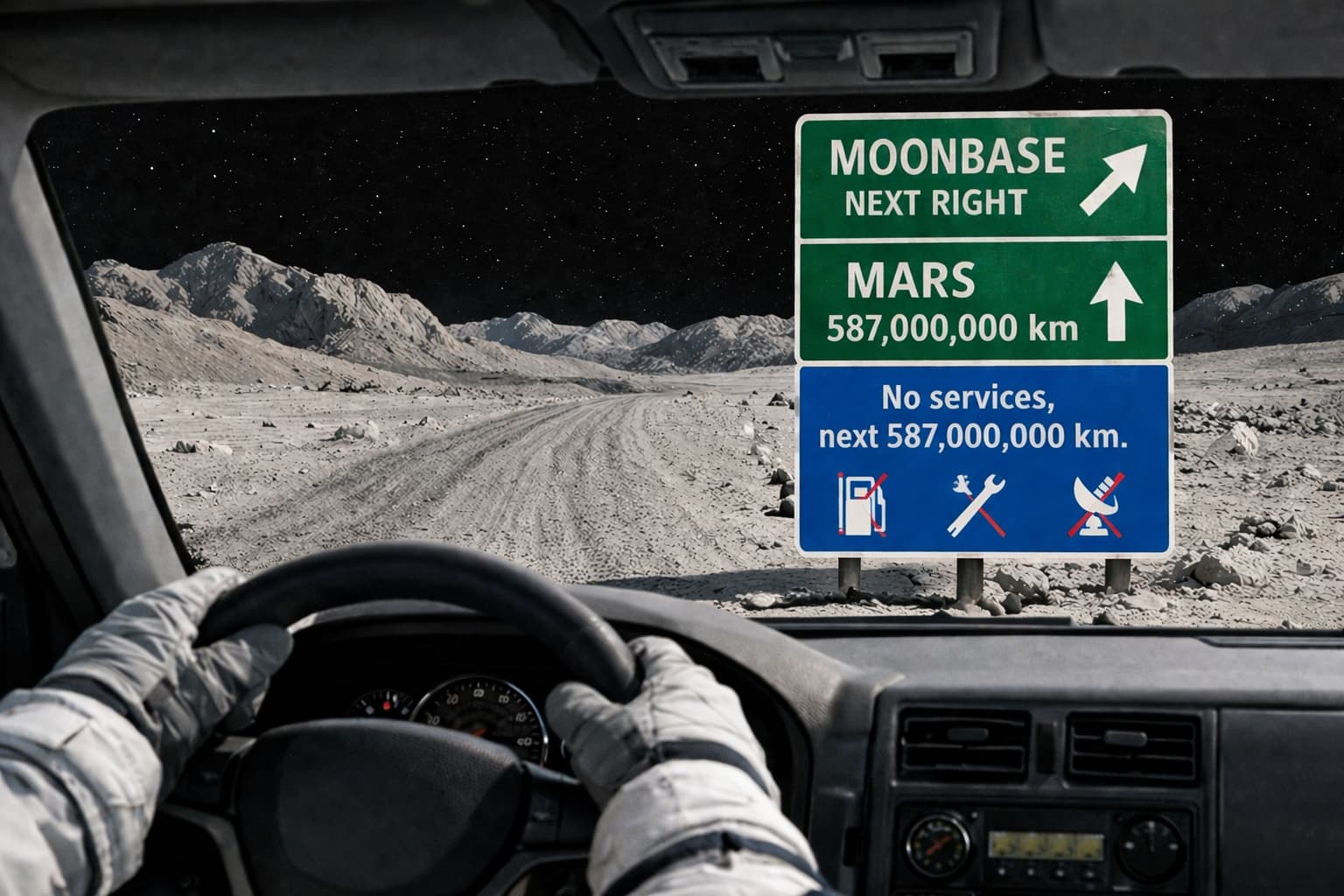
For years, people mused about the relative merits of missions to the Moon versus Mars. Is the Moon a stepping stone, or a distraction? A revitalized and refocused NASA moved the arrow toward Earth's satellite. So now does the road to Mars go through the Moon? An answer stems from the state of rocket technology, which reaches extraterrestrial destinations via a quick, strong, chemical rocket burn followed by a long glide path. Rockets are more potent than ever, but getting to Mars that way requires crossing a vast distance in a coasting trajectory, taking six months or longer, versus a week or less to reach the Moon.
Chemical rockets are and will remain the kings of thrust. For crossing extremely long distances more quickly, slow and steady wins the race. The math of rocketry changes when engines burn for days, using energy from nuclear reactions to hyper-accelerate propellants. Nuclear electric propulsion (NEP) exists, at least in principle, but is years away from general use. Earth-Mars transit is a long distance, but really doesn't involve a long enough time to get the most of the benefits that nuclear electric propulsion offers. Visiting the red planet still requires chemical rockets, and forces visitors to endure radiation and low gravity for extended periods before reaching it. Most methods for moderating the effects of these evils require systems that are too massive to be incorporated into missions that rely on chemical rockets. You have to really want to go, and be willing to accept the risks. Later, when NEP becomes more feasible, Mars missions should be able to carry more mass that can be devoted to crew protection.
Many things need to happen before humans set foot on Mars. Taken all at once, they appear monstrously formidable. But like anything worth tackling, it helps to practice and implement advances one at a time, while moving forward on all of them through thought, study, planning, and experimentation. With that in mind, although the Moon is a wretched place to establish a human colony, it does present reasons for a heavy and continuous human presence. Most importantly, it provides a closer test bed for innovation and learning. Put simply, safe exploration of Mars requires reliable technology and procedures. It's a hostile and unforgiving place for anyone who visits with unproven or trouble-prone power and fuel production systems. Your machinery for survival has got to work.
Things to improve or perfect in the Lunar environment before manned missions to Mars include space suits, dust mitigation, radiation shielding, solar and nuclear power production, battery technology, extraction and purification of water from soil or regolith, electrolysis of water to produce oxygen and rocket fuel, production and use of building materials from regolith, rover mobility and operation, closed-loop life support operation, human psychology factors, and AI-assisted operations including autonomous navigation and repair. None of these are starting from scratch. All are important and can be tested and improved. Do they have to work reliably for humans wanting to work on Mars? You bet your life!
Kevin Kelly, April 2, 2026